by Marietjie Poggenpoel

Muscles are Responders, Not Initiators
Muscle activity is initiated by the brain in response to internal and external stimuli. Even the most complex cognitive processes depend on effective muscular response for execution. Without strong, responsive musculature, there can be no purposeful movement, even basic postural control, speech, eating, not to mention no writing or reading would be possible.
Muscle development follows a hierarchical process: awareness → strength → coordination → control. This unfolds anatomically in a cephalocaudal (head to toe) and proximodistal (center to periphery) sequence, beginning with gross motor skills and advancing toward fine motor control. Large skeletal muscles stabilise the trunk and limbs, while smaller muscle groups enable refined tasks such as speech articulation, fine motor manipulation, and binocular coordination for visual tracking.
Gravity, Muscle Tone, and Posture
In Gravity: A Missing Link in Child Development (2020), Melodie highlights that muscle tone is a force that actively opposes gravity. Muscle tone enables a child to maintain upright posture, focus attention, and respond efficiently to environmental stimuli – whether internally driven or externally cued.
Muscle tone is not only vital for movement, but also essential for speech and auditory processing. Otolaryngologist Dr Alfred Tomatis (1983) demonstrated a relationship between facial muscle tone and the tone of the tiny muscles in the middle ear. These muscles play a crucial role in sound conduction and auditory processing – integral components of listening and language development.
Gravity, Muscle Tone, and Posture
The Mind Moves Institute employs a biomimetic approach, replicating natural movement patterns observed in healthy infants as they progress from foetal positioning to upright walking (typically by 23 months of age). This developmental sequence, consistent across cultures and environments, is driven by vestibular system maturation and gross motor experiences.
Through structured, equipment-free movement interventions, the Mind Moves Programme stimulates the vestibular system, thereby improving balance, coordination, and postural control. Once vestibular efficiency is achieved, movement – such as skipping with a rope – becomes more efficient, concentration improves, and the cognitive load required to maintain balance is reduced.
As Rowe has stated, “the most advanced movement is stillness” – achieved only when balance is fully integrated.

Primitive Reflex Integration and Neurodevelopment
Extensive research from the Mind Moves Institute confirms that most learners with emotional, behavioural, and academic challenges retain active primitive reflexes beyond the typical developmental window. While primitive reflexes are adaptive and functional during infancy (up to 6 months post-term), they become maladaptive if retained beyond this age, impeding neurodevelopment.

Primitive reflexes must be myelinated and integrated through repetitive physical interaction with the environment before voluntary, controlled movement can emerge.
Neurodevelopment is not random but follows an innate, hierarchical blueprint. Proper myelination of neural pathways occurs through repetitive interaction with the environment. All primitive reflexes must be fully integrated before voluntary, controlled movement can emerge. Once physical self-regulation is achieved, cognitive and behavioural regulation becomes possible.
If one or more primitive reflexes remain active, neurodevelopment is considered atypical. Such children may present with immature behaviour and poor impulse control, often appearing developmentally delayed despite chronological age.
According to Melodie, “movement is medicine”. This encapsulates the rationale for incorporating skipping with a rope as a dynamic and playful therapeutic activity to support postural development and neuro-integration. Mastering this complex, gravity-defying movement reflects the maturation of balance, coordination, and sensory-motor integration.
Skipping as a Neurodevelopmental Milestone

Developmental milestones must occur in a specific, sequential order. The acquisition of muscle tone – the resistance to gravity – is foundational and must precede controlled motor skills such as skipping. As Krebs stated, “The human body was designed to move. It is the early experiences that lay the foundation of what follows.”
Goddard (2002) emphasised that gravity is the one universal force acting on all individuals. Skipping requires the body to dynamically oppose gravitational pull, thereby reinforcing gravitational security – a neurological state that provides a sense of orientation, stability, and readiness to learn.
Skipping with a rope represents an advanced, coordinated motor action requiring:
- Upright posture
- Core stability
- Coordinated, alternating leg movements
- Rhythmic timing and spatial awareness
- Focused visual attention.

Successful skipping indicates full engagement of static and dynamic balance systems. The body continuously adjusts against gravity, achieving gravitational security – a neurological state wherein the brain feels safe, centred, and ready to learn.
The Three Planes of Movement and the Inner Ear
Efficient movement across the sagittal (forward-backward), frontal (left-right), and transverse (rotational) planes is essential for balance. Each plane stimulates vestibular receptors in the otolith organs and semi-circular canals. When the head moves, otoliths shift within a gelatinous matrix, stimulating hair cells and sending signals via the vestibular nerve to the brain to determine spatial orientation (Marieb, 2000; Hogan, 2004).
Daily movement on playground equipment, such as swings and climbing structures, stimulates these systems. Skipping amplifies this stimulation, requiring precise coordination of visual, vestibular, and proprioceptive systems to maintain balance, timing, and direction.
Progressive Steps Toward Skipping Proficiency

- Forward and backward stepping
- Stepping through a hula hoop (right foot, left foot, followed by overhead movement with verbal cues)
- “Jumping the dots” exercise (stepping on coloured markers with visual and verbal orientation)
- Two-footed jumps forward and backward
- Jumping over a swinging rope paced to the learner
- Rope length assessment (rope should extend from foot midpoint to underarm level for optimal control)
- Two-footed skipping in place, focused forward
- Skip in place, switching legs smoothly with focus and ease
- Advanced skipping with midline crossing while alternating legs.
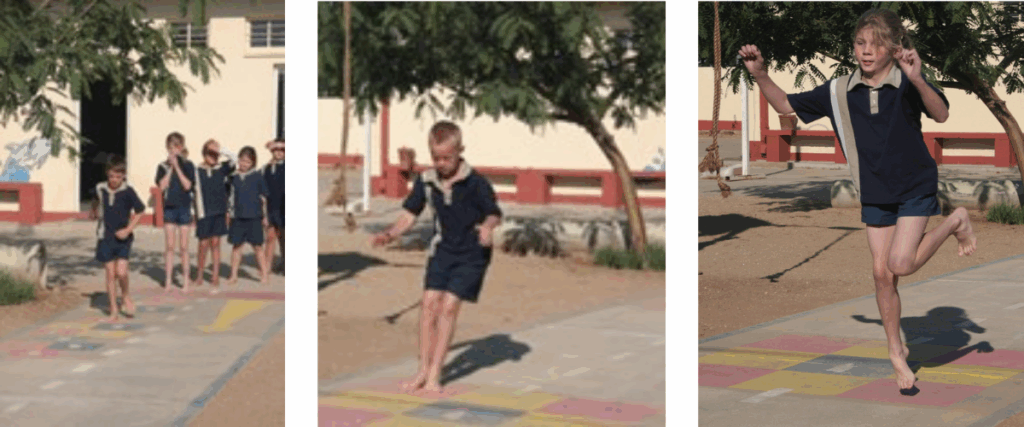


At the final level (step 9), skipping becomes a valuable academic brain break – a 1-2 minute reset between periods of focused cognitive effort (e.g., 40-minute study sessions in adolescents). This promotes continuous reflex integration and sustained cognitive performance.
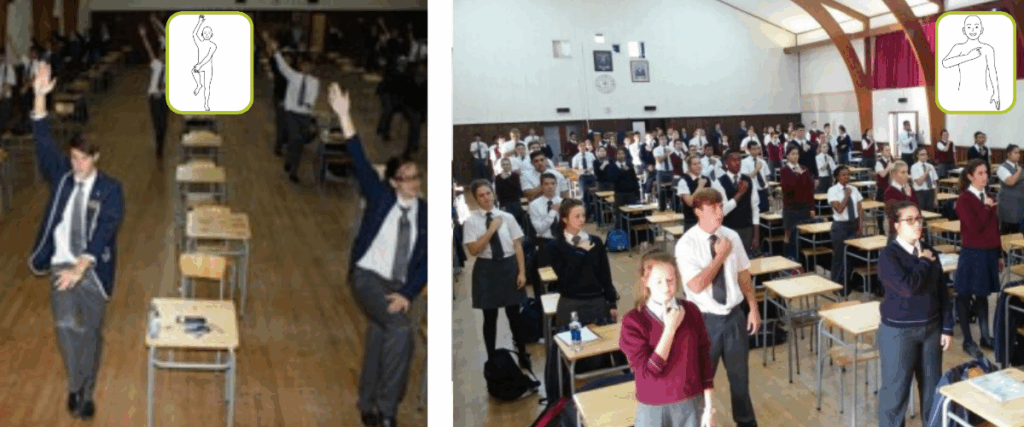
If skipping is not yet effortless and focused, this suggests underlying sensory-motor immaturity, and the preceding steps should be reinforced before progressing
.
Skipping as a Diagnostic and Therapeutic Tool
Skipping provides a real-time assessment of:
- Spatial orientation
- Directional awareness
- Bilateral integration
- Motor sequencing
- Focused attention
Children looking downward while skipping are still developing spatial awareness – a phenomenon referred to as “sole searching”. Their internal spatial “GPS” is not yet calibrated.
When skipping occurs with fluidity, posture improves, and the child displays a sense of body ownership and confidence. Neurologically, the act of skipping engages mathematical and scientific constructs such as timing, distance, speed, and velocity – often unconsciously.
During skipping, the child engages in subconscious calculations involving distance, speed, height, direction, and force – all in real time. Once these components are mastered, skipping becomes effortless and upright, indicating a developed sense of self and spatial orientation.
Melodie de Jager compares the vestibular system to a global positioning system (GPS):
- Proprioception: Where are my body parts in relation to each other?
- Vestibular input: Where am I in the environment? Where am I going?
- Kinaesthetic feedback: How do I prepare my muscles for movement?

Implications for Overweight Children and Self-Regulation
In children with higher body mass, the gravitational force is greater, requiring more developed muscle tone to perform skipping movements. Once balance and control are achieved, children experience increased behavioural regulation, self-confidence, and a positive body image – benefits closely tied to the successful integration of primitive reflexes and vestibular maturity.
In conclusion
Skipping with a rope, when performed effortlessly and with concentration, reflects a high degree of neurological integration, motor control, and cognitive readiness. It is both a developmental milestone and a diagnostic indicator. When integrated into educational and therapeutic settings, skipping serves as a powerful tool for enhancing postural stability, sensory-motor integration, and higher-order cognitive functioning.

Skipping is not merely physical activity – it is a precise neurological exercise that reinforces the brain-body connection, promotes learning readiness, and supports optimal child development.
- De Jager, M, 2016. Mind Moves® moves that mend the mind. Printed and bound by Business Press.
- Goddard, S. 2002. Reflexes, learning and behaviour. Oregon: Fern Ridge Press.
- Hogan, K. 2004. The ear and the Alexander Technique. https://www.kayhogan.com
- Marieb, E. N. 2000, Essentials of Human Anatomy &physiology (6th Ed). San Franciso
- Rowe as used in article https://www.mindmoves.co.za/2019/06/12/movement-muscle-tone-midlines-balance
- Tomatis, A, 1983 is referred to in De Jager, M; Efimov, O; Efimova, V. Gravity A missing link in the child development, 2020. Printed and bound by Novus Print Solutions.